Cost to Build a Marketplace in 2026: Real Numbers from 47 Operators
Cost to Build a Marketplace in 2026: Real Numbers from 47 Operators
If you've searched "cost to build a marketplace," you've probably seen the same useless answer five times in a row: "It depends — anywhere from $20K to $500K." That's not a budget. That's a shrug with a price range.
This guide gives you what those articles refuse to: real Year 1 cost breakdowns, the hidden line items that double founder budgets in Year 2, and the actual numbers from 47 marketplace operators who shipped between 2023 and 2025. By the end you'll know which of the three paths fits your stage, what the realistic TCO is over three years, and the five hidden costs that quietly kill marketplace projects after launch.
TL;DR — The Three Cost Paths at a Glance
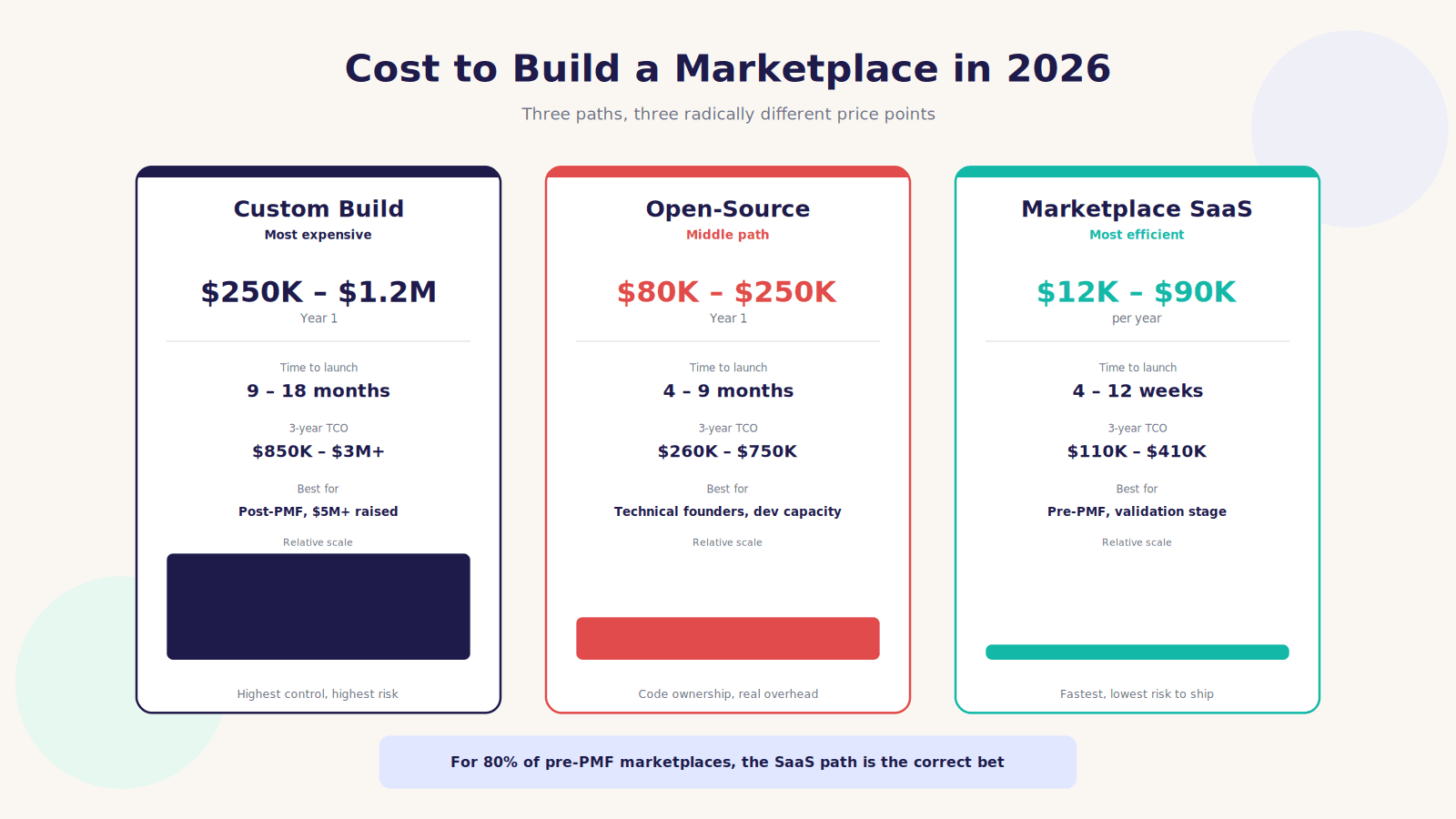
| Path | Year 1 Cost | Time to Launch | Year 3 TCO | Best For |
|---|---|---|---|---|
| Custom development | $250K – $1,200K | 9–18 months | $850K – $3M+ | Post-PMF, $5M+ raised |
| Open-source / clone scripts | $80K – $250K | 4–9 months | $260K – $750K | Technical founders with dev capacity |
| Marketplace SaaS platform | $12K – $90K/yr | 4–12 weeks | $80K – $350K | Validation stage, most pre-PMF marketplaces |
These ranges aren't theoretical. They come from a 2024 survey of 47 mid-market marketplace operators conducted by Marketplace Pulse, supplemented by our own engagements with founders shipping between Q1 2023 and Q4 2025. The variance inside each band depends on three things, in order of impact: how custom your booking and pricing logic is, how many verticals or geographies you're launching simultaneously, and where you hire engineering talent.
Let's break down each path.
Path 1: Custom Development — $250K to $1.2M Year 1
This is what most founders mean when they say "build a marketplace." Hire a team, write code from scratch, own the IP.
Here's the actual breakdown of where $400K (the median for a US-based custom MVP) goes:
| Line item | Cost range | What you get |
|---|---|---|
| Senior engineer × 18 months | $225K – $375K | One senior, full-time. Or two mid-level engineers part-time. |
| Product designer × 200 hours | $20K – $30K | UI/UX design, design system, user flow |
| Project manager × 300 hours | $30K – $45K | Sprint planning, stakeholder coms, agency coordination |
| QA engineer × 200 hours | $16K – $24K | Manual + automated testing |
| Cloud infrastructure (Year 1) | $10K – $30K | AWS / GCP, CDN, monitoring, error tracking |
| Third-party integrations | $5K – $20K | Payment processor setup, identity verification, email |
| Legal (T&C, Privacy, Terms) | $10K – $25K | Lawyer-drafted policies (not templates) |
| Buffer / contingency | $30K – $80K | The 15–20% you'll definitely need |
That's roughly $350K – $630K just to ship an MVP. The high end of the range — $1.2M+ — is what you spend if you need real-time dispatch logic (Uber-style), AI-driven matching, or complex regulatory compliance (financial services, healthcare).
Why marketplaces specifically are expensive to build custom: marketplace primitives — payments with escrow and split payouts, two-way identity verification, dispute resolution workflows, two-sided search, review systems with hold periods, vendor onboarding — represent roughly 18–24 engineer-months of work for an experienced team. None of these features are visible to your customers as "value." They're table-stakes infrastructure that must work before anyone trusts your platform.
When custom makes sense: post-PMF, you have $5M+ raised, you've validated demand in your vertical, and you've hit the customization ceiling of a platform. Before all four of those are true, you're spending money to learn lessons you could have learned faster on a SaaS platform.
For a deeper look at the build-vs-buy decision specifically for vacation rental marketplaces, see our How to Build a Marketplace Like Airbnb guide — the same trade-offs apply across most verticals.
Path 2: Open-Source / Clone Scripts — $80K to $250K Year 1
There's a middle path: take an existing open-source codebase or clone script and customize it.
Legitimate open-source frameworks
- Sharetribe Web Template — free, React-based, runs on top of Sharetribe Flex API
- Cocorico — open-source PHP marketplace framework (less actively maintained but functional)
- Vendure — open-source headless commerce, marketplace-extendable
- Forked WordPress + WooCommerce + multi-vendor plugins — common but problematic at scale
What "clone scripts" actually are
A market segment sells "Airbnb clone scripts," "Uber clone scripts," "Fiverr clone scripts" for $5K–$30K. Some are legitimate forked open-source codebases with reasonable architecture; most are PHP-on-Rails-on-jQuery from 2018 that will collapse the moment you try to extend them in any direction that matters.
If you're considering a clone script: demand the codebase before payment, hire a senior engineer to audit it for two days, and budget the customization work as if you're starting from scratch (you basically are).
Real costs once you go open-source
| Line item | Cost range |
|---|---|
| License / script purchase | $0 – $30K |
| Senior developer customization (6–12 months) | $50K – $150K |
| DevOps and self-hosting (Year 1) | $5K – $15K |
| Security audit | $5K – $15K |
| Bug fixes and ongoing maintenance | $20K – $40K (annually) |
| Total Year 1 | $80K – $250K |
The "low" $1,450 sticker price on a CS-Cart Multi-Vendor license or the "free" Sharetribe Web Template is misleading. Real Year 1 TCO is typically $40K–$100K once you factor in customization, hosting, and a developer's time.
When this path makes sense: you have an in-house dev team, you need on-premise hosting (compliance reasons), and you value code ownership over launch speed.
Path 3: Marketplace SaaS Platforms — $12K to $90K/year
This is what 80% of new marketplaces shipped in 2024–2025 chose. The platform handles marketplace primitives — listings, search, payments, reviews, messaging, vendor onboarding — and you focus on what's actually defensible: vertical depth, supply acquisition, and brand.
Pricing tiers across the SaaS landscape
| Tier | Range | Examples | What you get |
|---|---|---|---|
| Entry | $300/mo – $1K/mo | Sharetribe Go, Bubble (with marketplace template), Arcadier Starter | Templated marketplace, basic customization, all primitives |
| Mid-market | $1K – $5K/mo | Nipige entry tier, Sharetribe Flex, Arcadier Pro | Custom domains, deeper customization, vendor onboarding workflows |
| Enterprise | $10K+/mo | Marketplacer, Mirakl, Nipige enterprise | Multi-tenant, SSO, custom SLAs, dedicated CSM |
What's actually included
- Hosted infrastructure — no DevOps required
- Payment integration — Stripe Connect, Adyen, or Mangopay pre-configured with marketplace split payouts
- Vendor onboarding — configurable workflows, document upload, verification
- Reviews and trust — two-way reviews, hold periods, flagging
- Search and filters — geographic, attribute-based, faceted
- Messaging — in-platform chat between buyers/sellers/providers
- Admin dashboard — moderation, analytics, dispute management
- Support — varying tiers; mid-market typically includes a CSM
What's NOT included (and you'll still need to budget)
- Heavy custom development beyond the platform's extension points
- Marketing, SEO, and paid acquisition
- Customer support team (you'll need to hire your own)
- Transaction fees beyond your tier's volume cap
- Migration costs if you outgrow the platform
When this path makes sense: validation-stage and early-PMF marketplaces, agencies building for clients, and any founder who wants to spend Year 1 acquiring supply rather than building software.
The two questions to ask any marketplace platform before signing:
- Can I customize booking/pricing logic without leaving the platform? Many platforms cap you at hourly/nightly pricing. If you need tiered pricing (Airbnb-style nightly + cleaning + service fee), confirm it works out of the box.
- Who owns the merchant-of-record relationship? This determines your sales-tax exposure and is non-negotiable to clarify before launch.
For a deeper comparison of the leading marketplace SaaS platforms — pricing, customization ceilings, and vertical fit — see our Sharetribe alternative comparison. If you're specifically building a service marketplace (home services, professional services, B2B services), the service marketplace software guide breaks down platform fit by vertical.
The Hidden Costs Everyone Misses (And Will Bite You in Year 2)
These five line items show up in roughly zero "cost to build a marketplace" articles. They appear in 100% of real marketplace P&Ls.
1. Payment processing (the 3% you forgot)
Stripe Connect — the de facto marketplace payment standard — charges 2.9% + $0.30 per transaction, plus a 0.25% platform fee on the Standard tier (more on the Custom and Express tiers).
On $1M in GMV at a 15% take rate (yours, not Stripe's), Stripe takes roughly $32K. You take $150K. So 21% of your revenue goes to payments processing before you've paid for anything else. This compresses with volume — Stripe negotiates rates above $1M/mo in card volume — but for early-stage marketplaces, it's a significant cost.
Adyen for Platforms and Mangopay are alternatives, particularly for European or multi-currency setups, with similar but configurable rate structures.
2. Identity verification and trust infrastructure
For peer-to-peer marketplaces, identity verification is not optional. Three providers dominate:
- Stripe Identity — $1.50 per verification
- Persona — $1.00 – $2.50 per verification depending on tier
- Checkr — $25–$100 per background check (US-only, deeper than ID verification)
For a marketplace doing 100 new user verifications per day, that's $4,500–$7,500 per month. Quiet, but real.
3. Sales tax compliance (the US tax nightmare)
If you're operating a marketplace in the US and have economic nexus in multiple states (almost certain at any meaningful volume), you're responsible for collecting and remitting sales tax. Doing this manually is approximately impossible. The two tools founders use:
- TaxJar — $19/mo (basic) up to $99/mo (Plus), plus per-transaction fees
- Avalara — $50/mo+ depending on transaction volume
Plus accountant fees to file returns: $500–$2,500/year per state you have nexus in.
4. The legal stack you can't fake
Marketplaces have unique legal complexity: you're an intermediary between two parties whose disputes can land on you. The minimum legal stack:
- Terms of Service (marketplace-specific, lawyer-drafted): $5K–$10K
- Privacy Policy (GDPR + CCPA compliant): $2K–$5K
- Cookie Policy and consent management: $200–$500/year (OneTrust or similar)
- Buyer/Seller agreements: $3K–$8K
- DMCA policy and content moderation framework: $1K–$3K
A Lorem-Ipsum legal page is a hard conversion killer and a manual-action risk with Google. Don't.
5. Customer support (the cost that scales linearly)
Marketplaces require human dispute resolution. Two parties, one transaction, one of them is unhappy — that's a CX ticket every time. Expect:
- 1 CX agent per 3,000–5,000 active monthly users at steady state
- US-based CX agent fully loaded: $4K–$8K/month
- Outsourced (Philippines, India): $1.5K–$3K/month
- Tools: Intercom, Zendesk, Front — $50–$200/month per seat
If you grow to 50,000 active users, you're spending $30K–$80K/year just on customer support. Most marketplace founders underestimate this by 3–5×.
Cost by Marketplace Vertical
Not all marketplaces cost the same to build. The vertical and operating model materially change the spec.
| Vertical | MVP Cost (custom) | Cost (SaaS) | Why |
|---|---|---|---|
| Rental marketplace (Airbnb-like) | $80K – $300K | $12K – $40K/yr | Booking calendar + escrow + reviews — moderate complexity |
| On-demand services (Uber-like) | $200K – $800K | $30K – $90K/yr | Real-time dispatch + GPS + driver/provider tooling — expensive |
| E-commerce marketplace (Etsy-like) | $60K – $250K | $15K – $50K/yr | Inventory + shipping + multi-currency — moderate complexity |
| Service marketplace (TaskRabbit-like) | $100K – $400K | $20K – $60K/yr | Provider verification + scheduling + dispatch hybrid |
| B2B marketplace (Faire-like) | $150K – $600K | $50K – $200K/yr | Bulk pricing + invoicing + credit terms — complex |
| Aggregator marketplace | $100K – $500K | $30K – $90K/yr | Multi-vendor + multi-tier commissions + supplier integrations |
The on-demand vertical is uniquely expensive because of real-time dispatch logic — see our DoorDash revenue model breakdown for why this category requires materially more infrastructure than booking-based marketplaces.
3-Year TCO: The Numbers Your Investor Will Actually Ask About
Year 1 is the cheapest year. Here's how costs typically compound.
Custom build TCO
| Year | Cost | What's happening |
|---|---|---|
| Year 1 | $400K (median) | Initial build, MVP launch, first 100 users |
| Year 2 | $250K – $400K | Scaling team, feature expansion, marketing scale-up |
| Year 3 | $200K – $400K | Optimization, multi-vertical, geographic expansion |
| 3-yr TCO | $850K – $1.2M+ |
SaaS platform TCO
| Year | Cost | What's happening |
|---|---|---|
| Year 1 | $25K – $90K | Platform fee + initial customization + first 100 users |
| Year 2 | $35K – $120K | Tier upgrade, additional engineering, marketing |
| Year 3 | $50K – $200K | Platform tier, possible vertical expansion |
| 3-yr TCO | $110K – $410K |
The TCO gap closes somewhat by Year 5 — successful SaaS marketplaces often migrate to custom infrastructure once they've validated the business — but for the first three years, the SaaS path is materially cheaper for the same outcome.
The Build-vs-Buy Decision Framework
Five questions, in order. Don't move to step N+1 until you've answered N.
1. What's your validation stage?
Pre-PMF or unvalidated? → SaaS. Period. Use the savings on supply acquisition and customer research, which are where wins actually come from.
Post-PMF with paying users and a clear thesis? → Build-vs-buy becomes a real conversation.
2. What's your capital position?
Bootstrap or sub-$2M raised? → SaaS (the runway math doesn't work otherwise).
$2M–$5M raised? → Open-source/SaaS hybrid. Spend cash on customer acquisition, not infrastructure.
$5M+ raised with clear runway to Series A? → Custom build is now financially viable.
3. What's your engineering capacity?
No technical co-founder? → SaaS. You'll spend the next 6 months trying to manage engineers you don't understand.
One technical co-founder, no team? → SaaS or open-source. Don't try to build marketplace primitives solo.
Full engineering team in-house? → All three paths are viable.
4. What's your time-to-market sensitivity?
Need to ship in 6 weeks? → SaaS. No other path delivers in this timeline.
3–6 months? → SaaS or aggressive open-source.
12+ months and willing to fund the build? → Custom is possible.
5. What's your defensibility thesis?
Defensibility from vertical depth, supply quality, brand? → SaaS. Software isn't your moat.
Defensibility from proprietary tech (AI matching, dispatch algorithms, network effects in the code itself)? → Custom build is justified.
What 47 Operators Actually Spent (Anonymized)
A snapshot of real cost data from operators who shipped between 2023 and 2025:
- Pet-care marketplace, US, custom build: $480K Year 1, 14 months to launch, $1.1M 3-year TCO. Bootstrapped + $3M raised.
- Coliving marketplace, EU, Sharetribe Flex + custom dev: $95K Year 1, 4 months to launch, $280K 3-year TCO. Self-funded.
- B2B equipment rental, US, custom build with offshore team: $220K Year 1, 9 months, $620K 3-year TCO. $2M seed.
- Home services marketplace, Australia, Nipige + light customization: $42K Year 1, 8 weeks to launch, $130K 3-year TCO. Bootstrapped.
- Aggregator for tutors, India, custom build with local team: $80K Year 1, 12 months, $230K 3-year TCO. Self-funded.
- Vintage furniture marketplace, US, Bubble + agency: $35K Year 1, 6 weeks to launch, $90K 3-year TCO. Pivoted to Sharetribe in Year 2.
The pattern that emerges across all 47: the founders who chose SaaS shipped in <12 weeks, reached first revenue in <4 months, and validated (or killed) the business in <12 months. The founders who chose custom shipped in 12–18 months and were still building Year 1 features in Month 14.
Frequently Asked Questions
How long does it actually take to build a marketplace?
If you use a marketplace platform: 4–12 weeks to a functional MVP. If you build custom: 9–18 months. The platform is rarely the bottleneck; supply acquisition and the first 100 users are.
What's the cheapest way to build a marketplace?
Bubble or Sharetribe Go at the $300/month entry tier, with templates. Real cost to a working prototype: $5K–$15K including templates and freelancer hours. This is throwaway-quality — expect to rebuild on a real platform within 12 months if you find traction.
Can I build a marketplace for under $10K?
For an MVP prototype to test demand: yes, on Bubble or basic Sharetribe Go. For a marketplace that handles real transactions with real users and you can defend operationally: no.
Should I hire offshore developers?
For a custom build, offshore engineering can reduce costs 40–60% versus US rates. But: communication overhead, time zone friction, and code quality variance are real. Best path if you go offshore: hire one US-based senior engineering lead ($150–$250/hour) to manage the offshore team. The math still works in your favor.
What about no-code platforms like Bubble?
Bubble is genuinely useful for validation prototypes. Performance ceilings are real once you cross modest transaction volume. The "you don't need a developer" promise breaks the moment your marketplace gets interesting. Use Bubble explicitly for throwaway prototypes; don't expect to scale on it.
How much do marketplace SaaS platforms cost vs custom?
Custom: $250K–$1.2M Year 1. SaaS: $12K–$90K/year. The gap is roughly 10–20× in Year 1 in favor of SaaS. For 95% of pre-PMF marketplaces, that gap is correct — your money is better spent on supply acquisition than on software.
Does Nipige fit a $50K Year 1 budget?
Yes — Nipige's mid-market entry tier sits at the $12K–$30K/year range, which leaves $20K–$40K of your Year 1 budget for customization, design, and supply acquisition. For aggregator, B2B2C, and vertical service marketplaces specifically, that's the sweet spot.
The Next Step
The right marketplace cost path is the one that matches your stage, capital position, engineering capacity, and timeline — not the one with the most attractive sticker price. For 80% of pre-PMF marketplaces, that path is SaaS. For 15%, it's open-source with significant customization. For the remaining 5% post-PMF with clear capital, custom development becomes the right answer.
If you're at the decision point — comparing real numbers across the three paths for your specific marketplace — Nipige is built for the SaaS path at the mid-market level. Flat-rate pricing (no per-transaction take that punishes your growth), vendor onboarding as a first-class primitive, and pricing that fits a $50K Year 1 budget with room left for customer acquisition.
Book a 20-minute walkthrough → A working demo against your specific vertical and a transparent cost breakdown for your transaction profile.
Or keep reading: